top of page
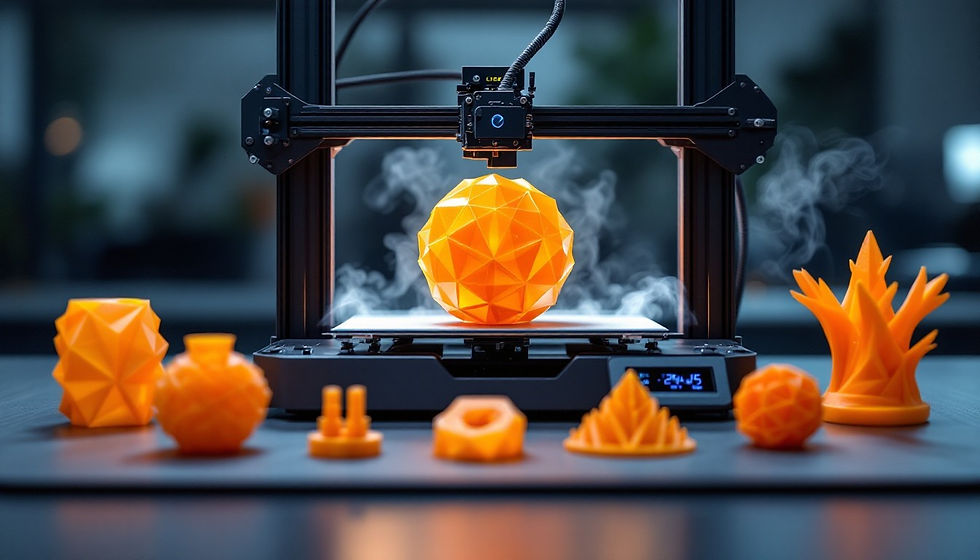
Precision and Detail
Additive manufacturing allows for incredible accuracy and intricate detailing in production. Offers unmatched precision and complexity for diverse industries.
Precision and detail are the cornerstones of additive manufacturing, making it a preferred choice for industries that demand high accuracy and intricate designs. By using advanced technologies such as stereolithography (SLA) and fused deposition modeling (FDM), additive manufacturing achieves tolerances as fine as microns, ensuring unparalleled accuracy in production.
The ability to fabricate complex geometries with precision opens up endless possibilities. Intricate lattice structures, micro-scale components, and detailed textures can be produced effortlessly. This capability is especially critical in sectors like aerospace, where lightweight yet strong components are essential, and in healthcare, where custom-fit implants and prosthetics must meet stringent accuracy requirements.
Unlike traditional manufacturing methods, additive manufacturing builds objects layer by layer, directly from digital models. This approach eliminates the need for molds or intermediate tooling, reducing the margin for error and allowing for exact replication of designs. Designers and engineers can experiment with innovative shapes and features without worrying about the constraints of conventional manufacturing processes.
Industries have already begun leveraging this precision to push boundaries. For example, in jewelry design, the ability to create intricate patterns and fine details has redefined craftsmanship. In automotive manufacturing, precision ensures that complex parts, such as engine components or aerodynamic prototypes, are built to exact specifications, enhancing performance and reliability.
Moreover, precision in additive manufacturing is not limited to prototypes. High-detail end-use products, such as dental crowns, hearing aids, and surgical instruments, are now produced with remarkable accuracy, meeting the highest industry standards. The repeatability of these processes ensures consistent quality across production runs.
In summary, the precision and detail offered by additive manufacturing are revolutionizing industries by enabling the creation of highly accurate and complex parts. Its ability to maintain consistency, innovate designs, and meet stringent standards makes it a critical technology for modern production challenges.


bottom of page